Low-Intensity Focused Ultrasound
Precision Therapy, Reimagined for PCOD and PCOS.
A fully modular, open-source LIFU platform — flexible, easy-to-use, and capable of delivering focused ultrasound to targets nearly anywhere in the head or body. Designed for discovery, built for translation.
Modular and configurable for many applications
The LIFU platform is flexible, easy-to-use, and can deliver focused ultrasound to targets nearly anywhere in the head or body. While devices are ready out of the box, the open-source design allows customization to support clinical research across diverse users and applications.
LIFU's controlled design features make it effective for developing regulated medical devices that are portable and low-cost — bridging the gap from proof-of-concept to commercially manufacturable hardware.
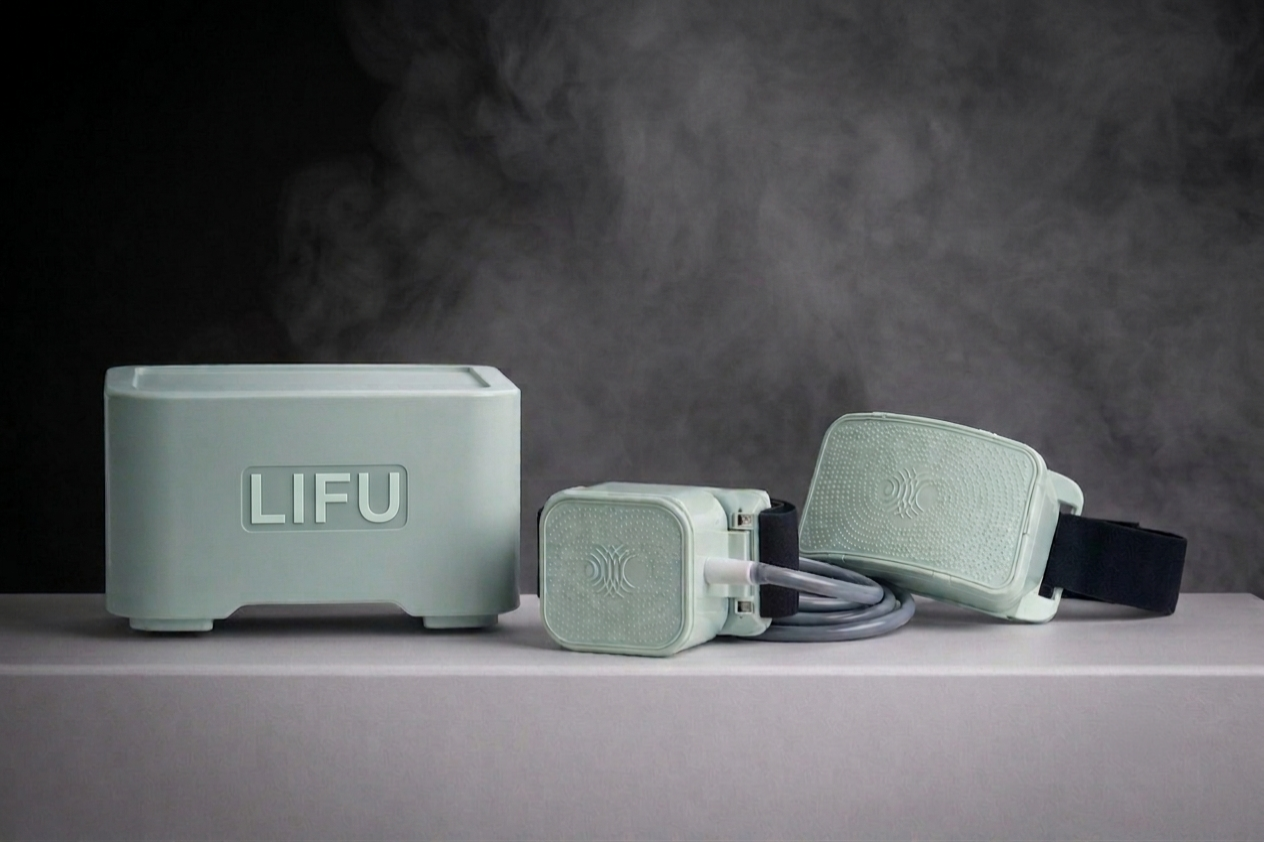
Three components. Infinite configurations.
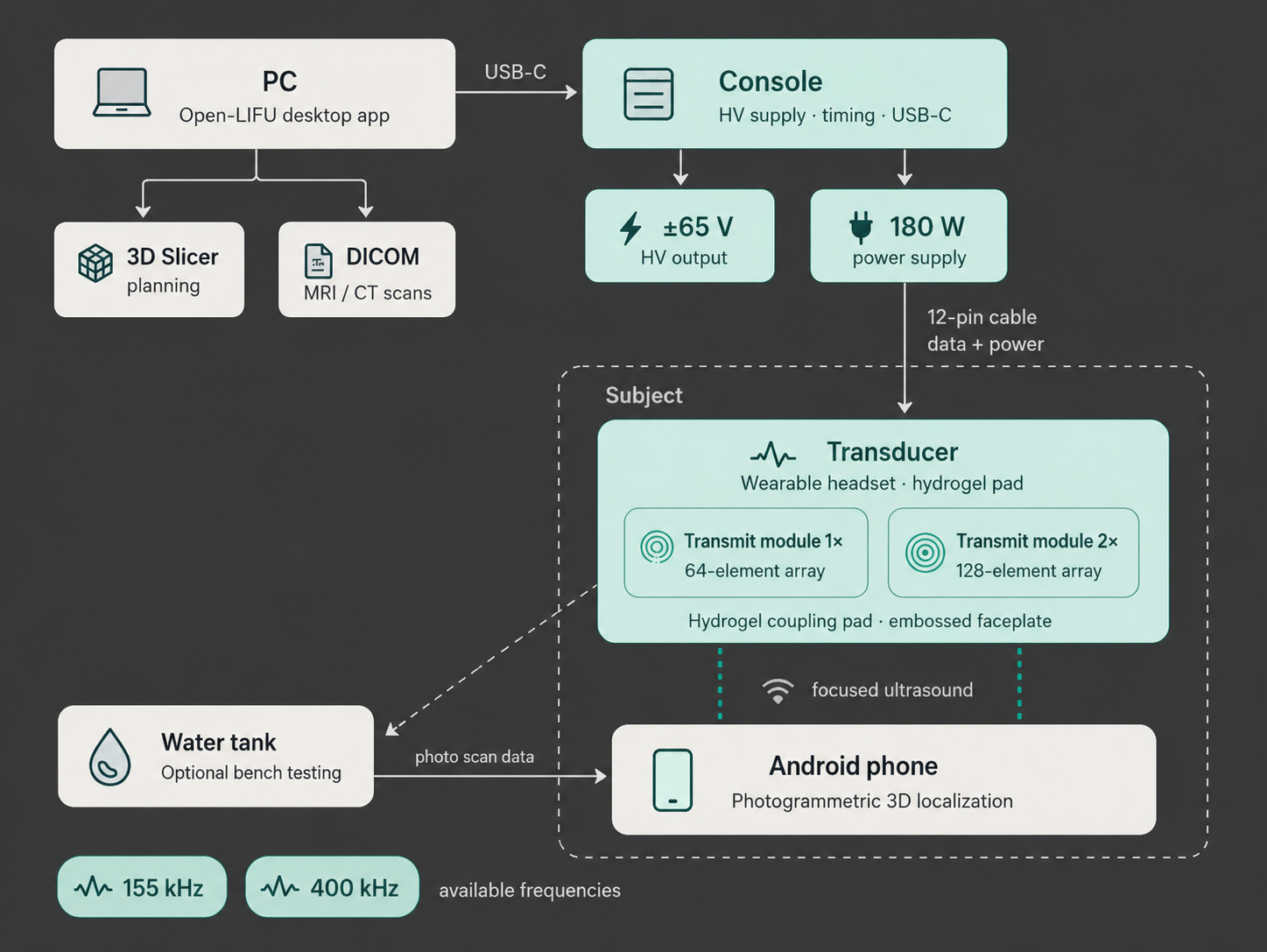
A clean separation of concerns — a powerful console, a wearable transducer, and the software stack that ties it all together. Each element is documented, serviceable, and open for extension.
Console
The control brain.
Generates high-voltage drive signals (up to ±65 V), coordinates timing, and communicates with your PC over USB-C. Compact at 3 lb — fits any lab bench.
Transducer
A wearable headset.
Houses one or two 64-element 2D matrix transmit modules. Ships with a disposable hydrogel coupling pad and spatial-localization markings built in.
Software Stack
Five layers, fully open.
From 3D Slicer treatment planning to a low-level transmit-module SDK. Runs on Windows 11 with NVIDIA CUDA for real-time processing.
Every parameter, fully programmable
per transmit module — 2D matrix array
for shallow or deep anatomical targets
Peak negative pressure — dual 400 kHz, derated
Axial steering range in 2× configuration
Programmable focal pressure range
Beamformer clock for sub-μs phase control
Transcranial Focused Ultrasound Neuromodulation of the Default Mode Network in the Treatment of Depression and Promotion of Wellness
Repetitive Negative Thinking (RNT) — including rumination and worry — is a transdiagnostic cognitive process central to major depressive disorder (MDD), generalized anxiety disorder (GAD), and obsessive-compulsive disorder (OCD). Elevated RNT is linked to increased connectivity within the brain's Default Mode Network (DMN), which supports self-referential thought and is often hyperactive in these conditions.
Emerging evidence suggests that low-intensity transcranial focused ultrasound (litFUS) may reduce Repetitive Negative Thinking and mood-related symptoms in clinical populations, and also promote emotional wellness in nonclinical groups.
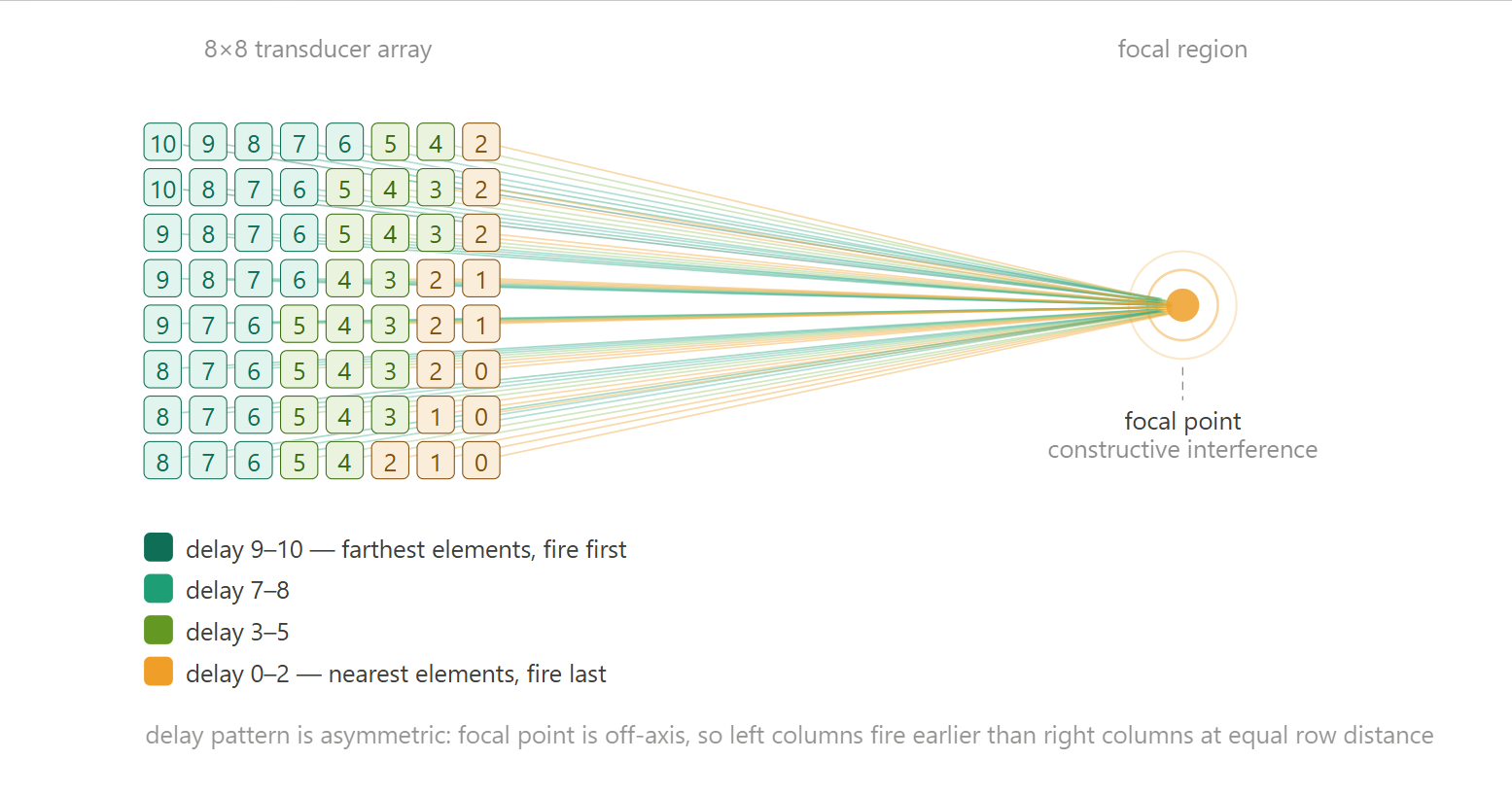
Every schematic, open and auditable
Open-LIFU isn't a black box. Every hardware schematic, firmware file, and software layer is published and community-licensed — so you can validate, extend, and build on a foundation you actually understand.
Fork the Repo
Submit PRs, file issues, contribute protocols
Discord Community
Researchers to neuromodulation teams
3D Slicer Integration
Familiar neuronavigation environment
Android Localization
Photogrammetric 3D targeting — no external tracker
Ready to explore LIFU for your research?
Get platform specs, clinical protocols, and direct access to our research team.